Dust storms and the air inside: what MERV and HEPA filters actually catch
Filed in Indoor air
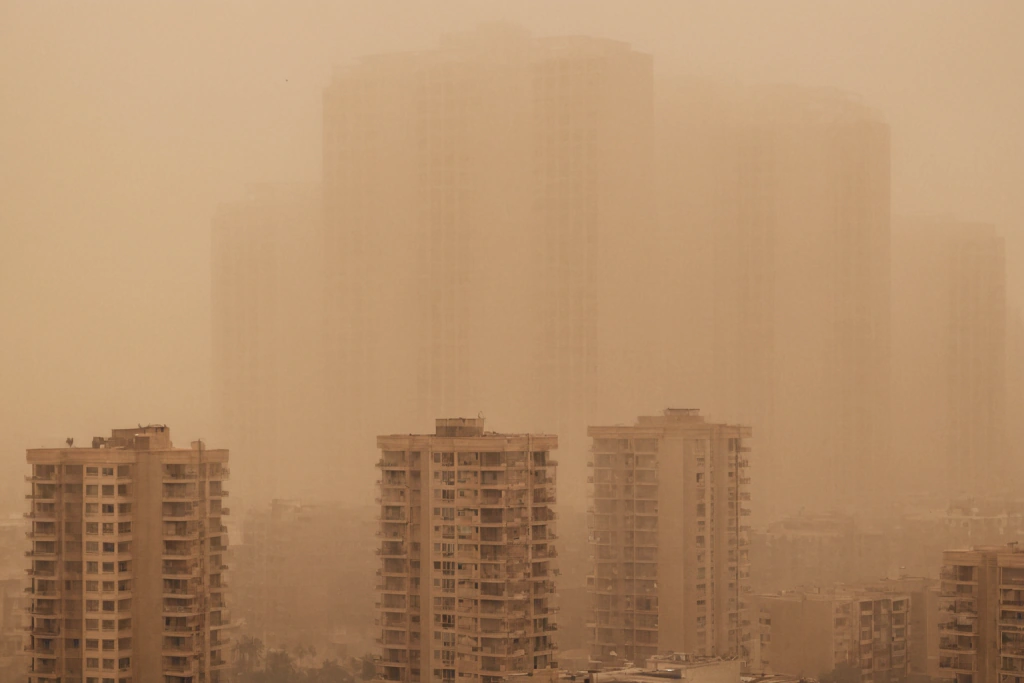
A closed window keeps out sand but not fine dust. The particles that matter for health are a few thousandths of a millimetre across and travel indoors through door gaps, window seals, extract fans and any fresh air intake. The filter that stops them is rated by MERV, a scale from 1 to 16 published by ASHRAE, and the US Environmental Protection Agency recommends MERV 13 or higher wherever a system can take it.
How often dust reaches UAE homes
Blowing dust is a regular part of the UAE year rather than a rare storm. In 2026 the National Centre of Meteorology (NCM) warned on 4 March of fresh to strong northwesterly winds causing blowing dust and sand, with horizontal visibility below 2,000 metres in some coastal and inland areas, according to the Emirates News Agency. On 29 July the NCM issued alerts as convective clouds brought rain, winds of up to 50 km/h and blowing dust that reduced visibility, Khaleej Times reported, with rain and dust in parts of Dubai the same evening.
The World Health Organization treats dust as a special case. The WHO's 2021 global air quality guidelines set numeric limits for fine particles in general but offer only good practice statements for particles from sand and dust storms, because the WHO found too little quantitative evidence to derive a separate guideline level for them. A dust day is therefore best handled as a day of high particle exposure, with the general advice for particles applied to it.
What a MERV number means
MERV stands for Minimum Efficiency Reporting Value. The rating comes from an ASHRAE test method and describes how well a filter captures particles between 0.3 and 10 microns in three size bands. The EPA's summary of the scale shows how quickly capture of the smallest band rises at the top of the range:
| MERV | 3 to 10 µm | 1 to 3 µm | 0.3 to 1 µm |
|---|---|---|---|
| 1 to 4 | less than 20% | not rated | not rated |
| 8 | 70% or more | 20% or more | not rated |
| 11 | 85% or more | 65% or more | 20% or more |
| 13 | 90% or more | 85% or more | 50% or more |
| 16 | 95% or more | 95% or more | 95% or more |
A HEPA filter sits outside the MERV scale. The EPA describes HEPA as a pleated mechanical filter that captures at least 99.97% of particles of 0.3 microns, the hardest size to catch, and captures particles larger or smaller than that with higher efficiency. Portable air purifiers usually use HEPA filters; ducted air conditioning usually uses MERV-rated filters.
Which filter a UAE home can actually use
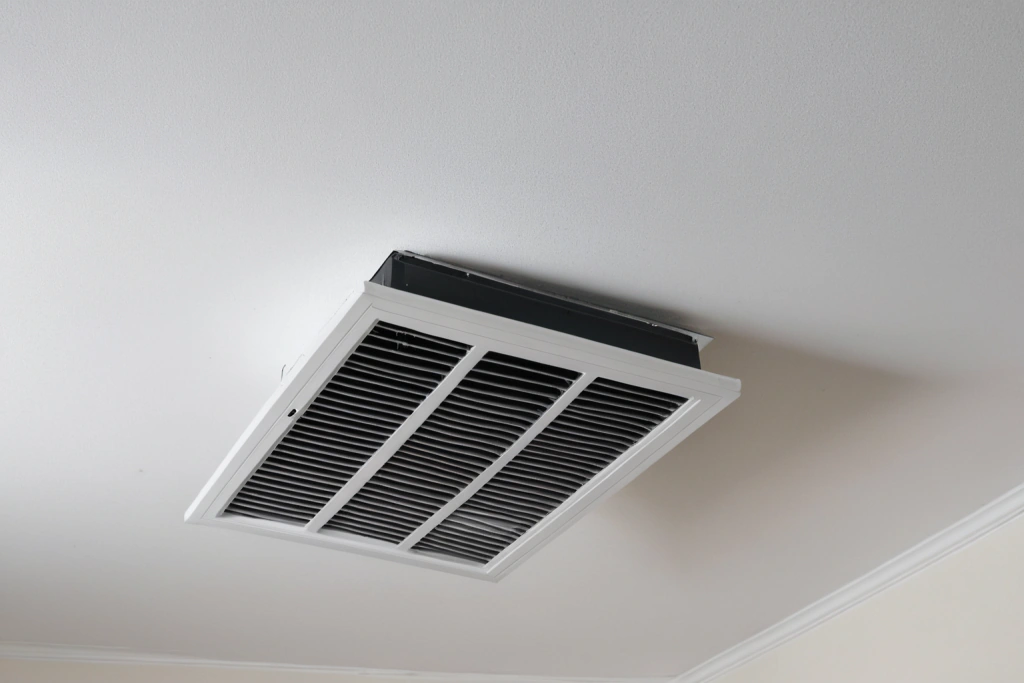
The filter a home can use depends on the type of air conditioning. A villa or large flat with ducted air conditioning usually has a return grille or filter slot that accepts a pleated filter, and the EPA notes that most such systems can take a MERV 13 filter without equipment problems, provided the filter is replaced often. A technician should confirm that the fan can push air through a denser filter, because a filter that is too restrictive cuts airflow and cooling.
A wall-mounted split unit is a different case. The mesh screen behind its front panel is there mainly to keep dust off the cooling coil, and it is not sold with a MERV rating. Cleaning that screen keeps the unit efficient, as the note on dirty filters and coils explains, but it is not a particle filter for the people in the room. In a home cooled by split units, a portable air purifier with a HEPA filter does the particle work.
Sizing a purifier for a dusty day
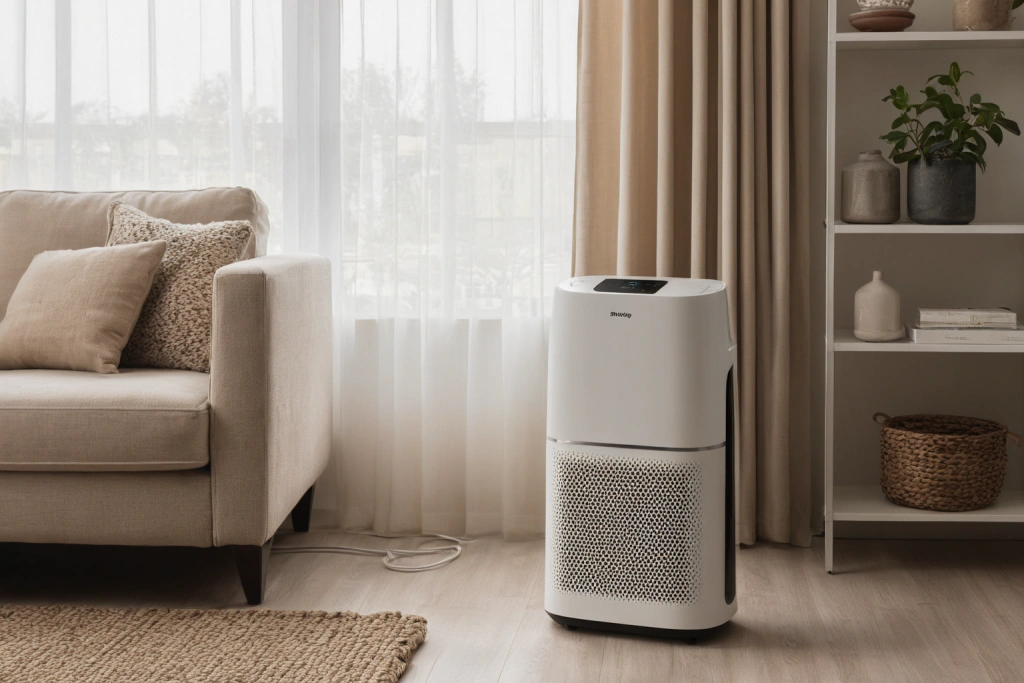
A portable air cleaner should be sized by its clean air delivery rate (CADR), and the EPA publishes a simple table for it. A room of 200 square feet, about 19 m², needs a CADR of at least 130 cubic feet per minute, and a room of 400 square feet, about 37 m², needs at least 260. The EPA advises looking at the CADR for tobacco smoke when the goal is small particles, since that figure represents the smallest particle sizes. The EPA also notes that higher fan speeds and longer running times increase the amount of air filtered.
A dust-day routine for a flat or villa
The EPA puts source control and ventilation first and filtration second; on a dust day the outdoor air is the source, so the order changes.
- Close windows and balcony doors when the NCM issues a dust alert, and keep them closed until visibility recovers.
- Run a HEPA purifier sized for the room where people spend most time, usually the bedroom or the living room, on a higher setting while the dust lasts.
- In a ducted system, fit the highest MERV filter the system can take and replace it after a dusty spell rather than on the calendar.
- Clean the mesh screens of split units after the storm, so that the units keep their airflow.
A closed flat on a dust day also traps whatever is released inside, so the same day is a bad one for frying without a hood, as the note on cooking fumes shows, and for gadgets that add ozone to a sealed room. The broader picture of dust, heat and humidity across the year is in the note on what a UAE summer does to a home.
Sources
- US Environmental Protection Agency (2026). What is a MERV rating?
- US Environmental Protection Agency (2026). Guide to air cleaners in the home
- World Health Organization (2024). Ambient (outdoor) air quality and health, fact sheet
- Emirates News Agency (WAM) (2026). NCM warns of dusty northwesterly winds, reduced visibility
- Khaleej Times (2026). Watch: Orange alert issued as dust storms, heavy rain hit Dubai, other parts of UAE