Why solid wood furniture splits in an air-conditioned room
Filed in Humidity and damp
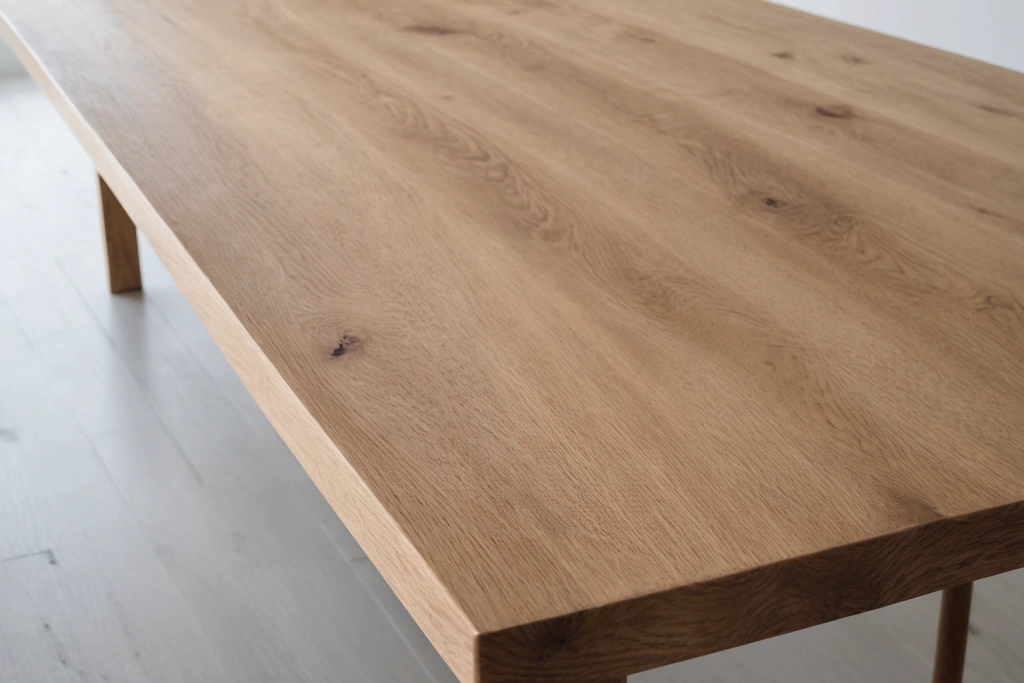
Solid wood splits in an air-conditioned room because it dries to match the air around it, and it shrinks as it dries. The US Forest Products Laboratory's Wood handbook gives the numbers: wood kept at about 30% relative humidity settles near 6% moisture content, while wood made or stored in air at 60% to 65% humidity sits near 11% to 12%. A flat-sawn oak board loses close to 2% of its width between those two states, and if the joinery holds it rigid, the board cracks.
Wood follows the humidity of the room
Every piece of wood moves toward an equilibrium moisture content (EMC), the moisture level at which it neither gains nor loses water, and that level is set almost entirely by the relative humidity of the surrounding air. Temperature matters much less in the range people live in. The Wood handbook's Table 4–2 shows the relationship:
| Relative humidity of the room | EMC at 21.1 °C | EMC at 26.7 °C |
|---|---|---|
| 20% | 4.5% | 4.4% |
| 30% | 6.2% | 6.1% |
| 40% | 7.7% | 7.6% |
| 50% | 9.2% | 9.1% |
| 60% | 11.0% | 10.8% |
| 65% | 12.0% | 11.7% |
Indoor air in air-conditioned UAE homes can be very dry. A team at Ajman University measured 23 new apartments in five towers in Ajman, all air-conditioned, and recorded indoor relative humidity between roughly 15% and 60%, with an average of 31.9%. The Ajman units were measured before anyone moved in, after a seven-day bake-out, so occupied homes with cooking, showers and people will usually sit a little higher. Even so, the study shows that a sealed, cooled flat in the UAE can hold air at around 30% humidity for long periods, which puts solid wood near 6% moisture content.
How far a tabletop moves
The Wood handbook gives a way to estimate the change in width of a board between 6% and 14% moisture content: multiply the width by a dimensional change coefficient for the species and by the change in moisture content. For flat-sawn white oak, the tangential coefficient is 0.00376 per percentage point of moisture.
A 900 mm flat-sawn white oak tabletop that moves from about 11% to about 6% moisture ends up about 17 mm narrower:
| Flat-sawn white oak, 900 mm wide | Moisture content | Width change |
|---|---|---|
| Built or stored in humid air (about 60% to 65% RH) | 11% | starting point |
| Brought into a room at about 30% RH | 6% | about 17 mm narrower |
The handbook warns that commercial boards are rarely perfectly flat-sawn, so this method tends to overestimate the change in width. The real movement of a mixed-grain tabletop will be somewhat smaller, but a shrinkage of 10 mm or more across a dining table is well within reach. A top that is screwed or glued tightly to its frame cannot shrink freely, and the stress releases as a split along the grain.
Why the crack runs along the grain
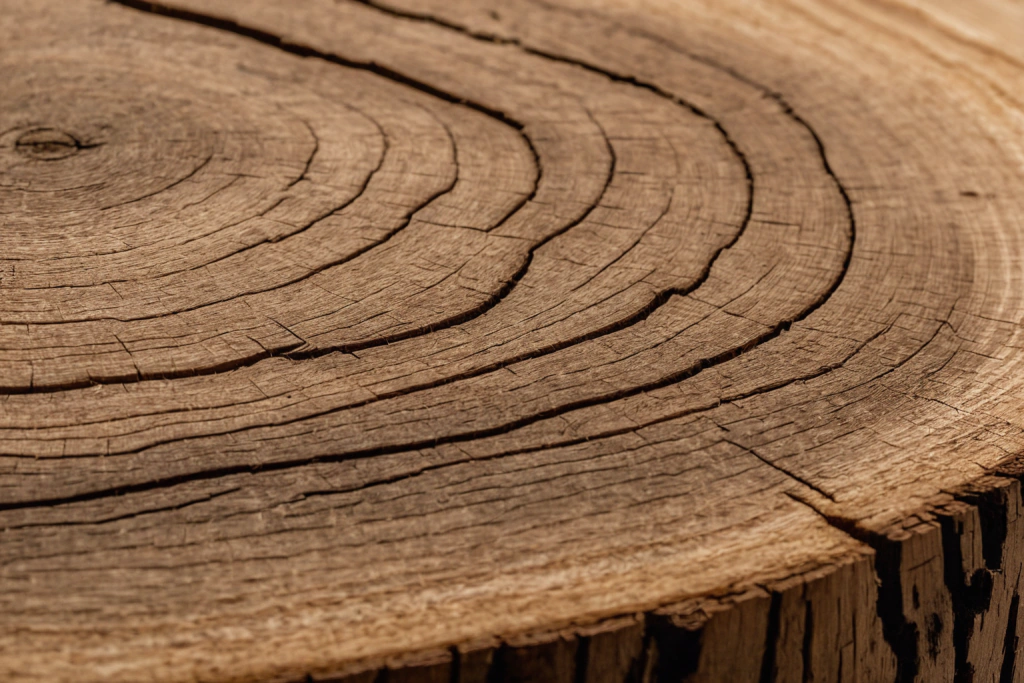
Wood shrinks unevenly in its three directions, and the uneven part is what does the damage. The Wood handbook states that tangential shrinkage, along the growth rings, is about twice the radial shrinkage, across them, and shrinkage along the length of the board is small, between 0.1% and 0.2% from green to oven-dry for most species. A flat-sawn board has its rings running across its width, so its width moves the most. The same uneven shrinkage makes boards cup, and it is the reason that wide panels of solid wood are traditionally fitted into grooves that let them float rather than glued in place.
What makers and owners can do
Buyers and owners can limit the damage at three points: the wood, the construction and the room.
- Ask what moisture content the wood was dried to. The Wood handbook recommends that interior woodwork, furniture and flooring be installed at the moisture content it will meet in service. For interiors in the dry southwestern United States it recommends an average of 6%, against 8% for most of the country and 11% for damp, warm coastal areas. A piece intended for an air-conditioned UAE room is closer to the dry case than to the coastal one.
- Prefer construction that lets wood move. Floating panels, slotted fixings that let a top slide on its frame, and breadboard ends that allow for movement all accept seasonal change. Plywood and veneered panels are more stable: the handbook notes that bonding wood layers with crossing grain gives much lower swelling and shrinkage with changes in humidity.
- Keep the room's humidity from swinging. Steady air does less damage than any single humidity level, because each swing forces the wood to shrink or swell again. Keeping a cooled room from dropping into the range of 20% to 30% relative humidity limits the movement; the note on the humidity range worth aiming for sets out what other targets apply, including the limits that keep dust mites and mould in check.
Furniture arriving from humid storage or from abroad
New furniture often changes climate on the way into a flat. Humidity is worst in coastal cities such as Dubai and Abu Dhabi, and the National Centre of Meteorology puts the average maximum relative humidity in August at 72%, as The National's explainer on UAE humidity reports. A piece that sat in a non-air-conditioned warehouse or a shipping container will have taken up moisture there. The first weeks in a cool, dry room are when the largest shrinkage happens.
Letting a new piece adjust slowly helps. Placing it away from the direct airflow of a split unit and out of strong sun through glass keeps it out of the most extreme air in the room while it settles. Sunlight through windows also heats surfaces, a subject covered in the notes on window film and curtains and blinds.
The same physics works in reverse in damp corners: wood near a wall with condensation or mould swells and stains. Wood in a home is a record of its humidity, and the cracks and gaps are where that record becomes visible.
Sources
- US Forest Products Laboratory, US Department of Agriculture Forest Service (2021). Wood handbook: wood as an engineering material (General Technical Report FPL-GTR-282)
- Jung, Mahmoud and Alqassimi, Ajman University, Frontiers in Built Environment (2022). Identifying the relationship between VOCs emission and temperature/humidity changes in new apartments in the hot desert climate
- The National (2023). Why does it feel so much hotter? Humidity in the UAE explained