Ceiling fans let the thermostat go higher: what Berkeley's comfort studies found
Filed in Heat and cooling
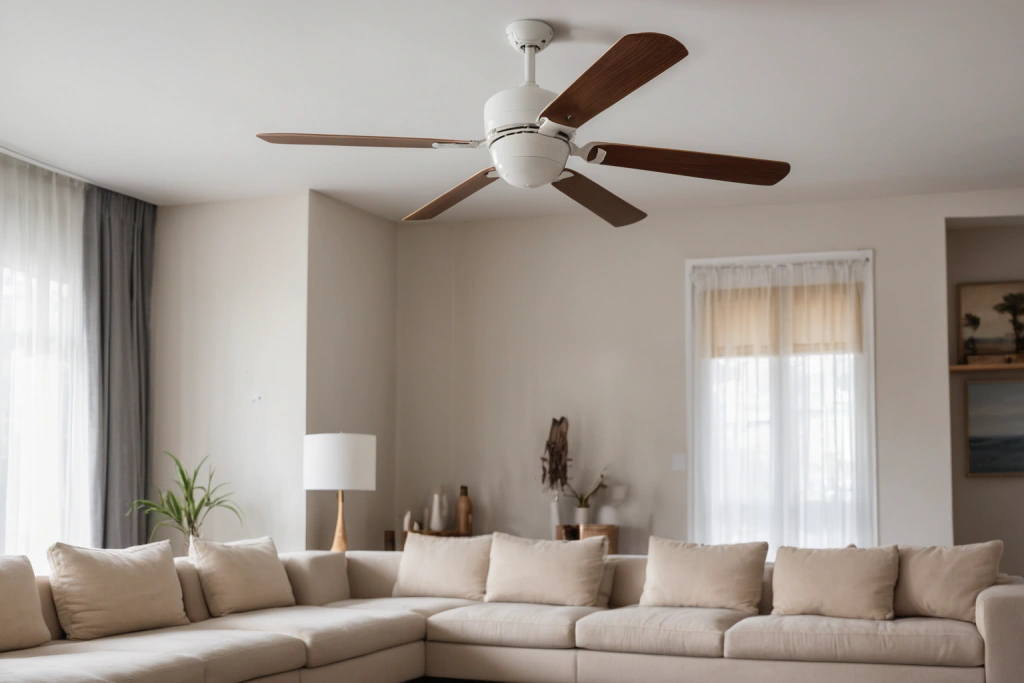
A ceiling fan lets a room stay comfortable at a warmer thermostat setting, and a warmer setting is where the savings are. Researchers at the Center for the Built Environment at UC Berkeley found that air moving at about 1 metre per second can offset a 3 °C rise in room temperature while improving how comfortable people feel, and estimated that each degree Celsius of higher indoor temperature cuts a building's total heating, ventilation and air conditioning energy by about 10%. The Dubai Electricity and Water Authority (DEWA) recommends 24 °C or higher and puts the saving at up to 5% of air conditioning consumption per degree.
Fans cool people, not rooms
A fan does not change the temperature of the air; it changes how fast the body loses heat. Moving air speeds up two ways the skin sheds heat, convection and the evaporation of sweat, which is why a breeze feels cooler than still air at the same temperature. UC Berkeley's Ceiling fan design guide, published in 2020, gives a sense of scale: an air speed of 0.5 metres per second, about half the speed of air past someone walking slowly, has a cooling effect of roughly 2 °C.
The practical consequence is simple. A fan running in an empty room uses electricity and cools nobody, so fans belong in the rooms that are occupied, and the design guide recommends controls that switch fans on only when a space is in use.
What the comfort tests found in humid air
The Berkeley team tested people in a climate chamber at temperatures and humidity levels close to a UAE evening. In the team's 2013 final report to the California Air Resources Board, moving air restored comfort at every condition tested:
| Room condition | Fans off | With moving air |
|---|---|---|
| 26 °C, 60% or 80% humidity | 50% of subjects wanted more air movement | At 0.7 m/s, 88% (60% humidity) and 75% (80% humidity) wanted no change |
| 30 °C, 60% humidity | 94% wanted more air movement | At 1.2 m/s, 81% wanted no change |
| 30 °C, 80% humidity | 94% wanted more air movement | At 1.6 m/s, 69% wanted no change |
Higher humidity called for faster air to reach the same comfort, which matters on the UAE coast. The same project found no significant differences in dry-eye discomfort under moving air at any test condition, which answers a common objection to sleeping or working under a fan.
How much a higher setting saves
Raising the thermostat is the step that turns comfort into savings, and several studies put numbers on it. Each figure comes from a different building type and climate, so they show the order of magnitude rather than a promise for a specific flat.
- DEWA: each degree of increase in the thermostat setting can save up to 5% of air conditioning consumption, and DEWA advises keeping it at 24 °C or higher.
- UC Berkeley, report to the California Air Resources Board: about 10% of total HVAC energy per degree Celsius, and more where a higher temperature lets a building switch from compressor cooling to ventilation.
- Hoyt, Arens and Zhang, Building and Environment, 2015: in simulations of office buildings, raising the cooling setpoint from 22.2 °C to 25 °C saved an average of 29% of cooling energy and 27% of total HVAC energy, and wider temperature bands made possible by fans or personal controls gave savings of 32% to 73% depending on the climate.
- Hot-humid Florida simulations cited by the Berkeley report: raising the cooling setpoint by 2 °C while using ceiling fans saved about 15% of cooling energy at the same level of comfort.
The Berkeley design guide adds that the HVAC savings from a well-used fan typically outweigh the fan's own energy use by a factor of 10 to 100, because a ceiling fan draws far less power than the air conditioning it lets you turn down.
A setting plan for a UAE home
For the warm months, a simple routine works; adjust it by feel.
- Set the air conditioning to 24 °C as DEWA recommends, with the ceiling fan on low in occupied rooms.
- Try 25 °C and then 26 °C with the fan on a medium setting; in the Berkeley tests, most people at 26 °C were content once the air moved.
- Switch fans off in rooms nobody is using.
- On humid evenings, expect to need a faster fan for the same comfort, as the tests at 80% humidity showed.
Where fans fit in the bigger picture
A fan works best when the room is not fighting the sun. Passive measures first and active cooling last is also the order spacecraft engineers follow, as the note on the Hope probe's thermal control shows. Shading glass with curtains and blinds or window film cuts the heat that reaches the room, and a clean air conditioner, as described in the note on filters and coils, delivers its rated cooling. Higher settings also show up directly on the bill, as the note on DEWA's slab tariff explains, and they matter at night too: the note on bedroom temperature and sleep looks at how warm a bedroom can be before sleep suffers.
Sources
- Arens and others, Center for the Built Environment, UC Berkeley, for the California Air Resources Board (2013). Air movement as an energy efficient means toward occupant comfort (final report, contract 10-308)
- Center for the Built Environment, UC Berkeley (2020). Ceiling fan design guide
- Hoyt, Arens and Zhang, Building and Environment (2015). Extending air temperature setpoints: simulated energy savings and design considerations for new and retrofit buildings
- Dubai Electricity and Water Authority (DEWA) (2026). Cooling: conservation tips