Do houseplants clean the air in an air-conditioned flat?
Filed in Indoor air
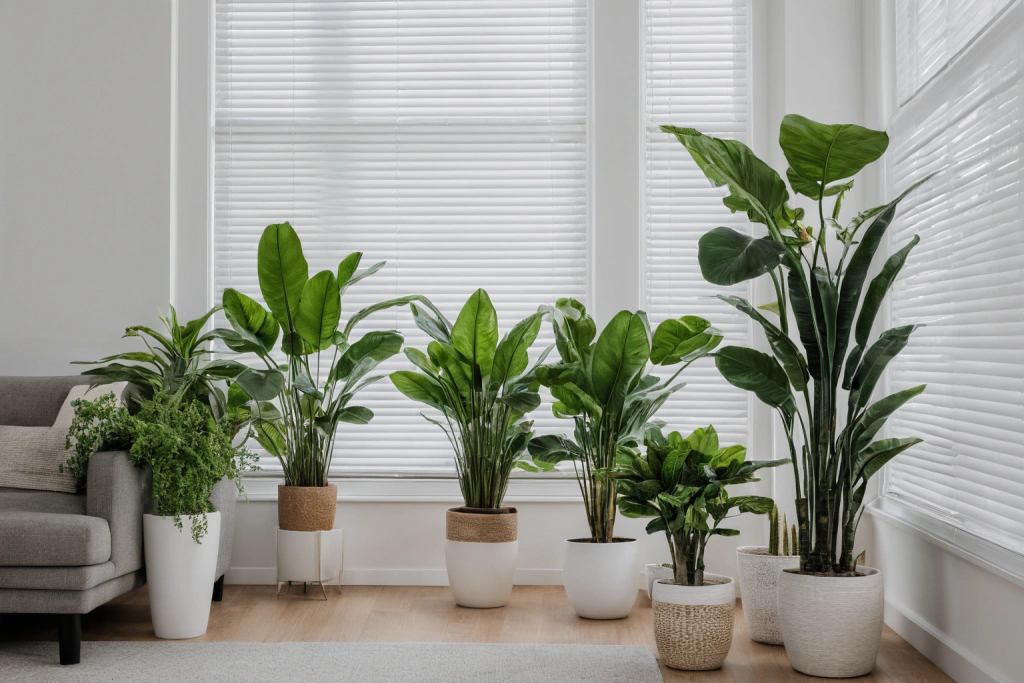
A potted plant does not clean the air of a lived-in room in any measurable way. A 2019 review in the Journal of Exposure Science and Environmental Epidemiology turned 196 laboratory results into one comparable number and found that a typical plant removes volatile organic compounds so slowly that a home would need between 10 and 1,000 plants per square metre of floor to match the cleaning that ordinary air exchange already provides.
Where the idea that plants clean air came from
The belief traces back to a 1989 NASA report by B. C. Wolverton and colleagues, titled "Interior landscape plants for indoor air pollution abatement". The NASA team placed plants in small sealed chambers, injected chemicals such as benzene and formaldehyde, and watched the concentrations fall over hours. The same report also described a different device: a fan that pulled air through activated carbon around plant roots, which is a filter with a plant attached rather than a plant on a shelf.
Chamber tests answer a narrow question. A chamber has no fresh air coming in, a small volume, and one dose of chemical, so even a slow removal process becomes visible after a day. A flat in Dubai Marina or Al Nahda has none of those conditions: air leaks in and out through doors, windows, kitchen and bathroom fans, and the chemicals come from furniture, cleaning products and cooking all day long.
What the 2019 review measured
Bryan Cummings and Michael Waring reviewed 12 published chamber studies and converted 196 experimental results into a clean air delivery rate (CADR), the same metric used to rate air purifiers. CADR is the volume of air per hour from which a device, or a plant, removes a pollutant completely.
The median plant in those studies delivered 0.023 cubic metres of clean air per hour. The authors compared that with the air exchange of a typical building, about one full change of indoor air per hour, and calculated that potted plants would have to cover the floor at a density of 10 to 1,000 plants per square metre before they matched the effect of normal air exchange. The review's title states the conclusion plainly: potted plants do not improve indoor air quality.
The arithmetic for a UAE bedroom
A small bedroom of 12 m² would need between 120 and 12,000 plants to match normal air exchange, and a 25 m² living room between 250 and 25,000.
| Room | Floor area | Plants needed at 10 per m² | Plants needed at 1,000 per m² |
|---|---|---|---|
| Small bedroom | 12 m² | 120 | 12,000 |
| Living room in a two-bedroom flat | 25 m² | 250 | 25,000 |
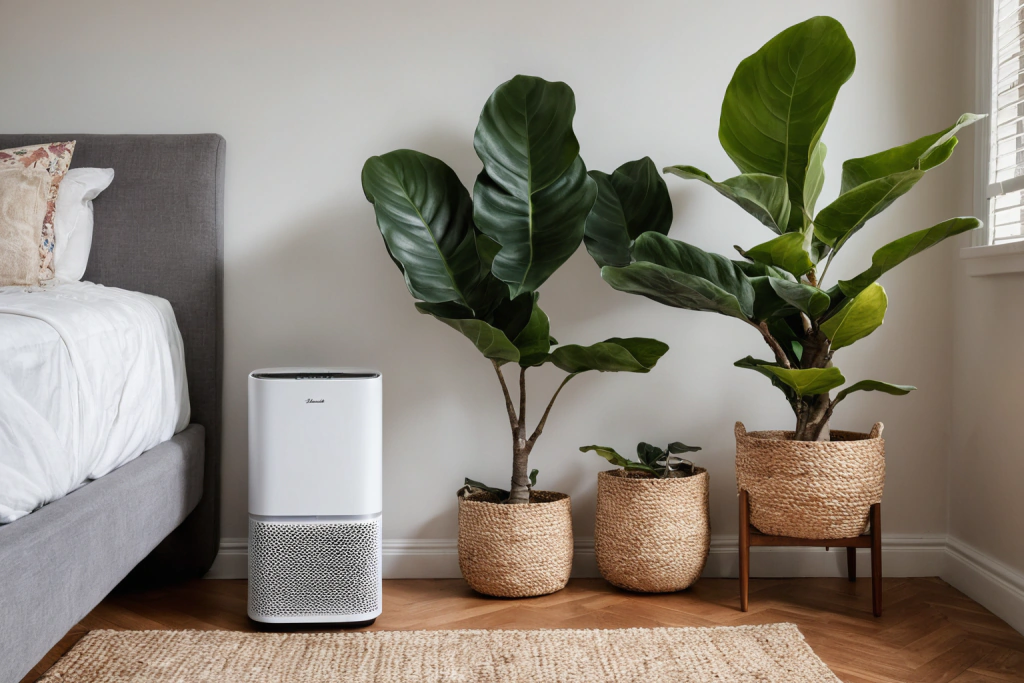
The US Environmental Protection Agency's guide to air cleaners gives a sizing rule for particle removal: a room of 100 square feet, about 9.3 m², needs a portable air cleaner with a CADR of at least 65 cubic feet per minute, which is about 110 cubic metres per hour. Divided by the median plant figure of 0.023 cubic metres per hour, one such air cleaner equals roughly 4,800 median plants. The EPA figure is for particles and the plant studies measured gases, but even so one purifier does the work of thousands of plants.
Why air-conditioned homes are a special case
Sealed, air-conditioned homes make the plant question more tempting and the plant answer no better. In summer many UAE households keep windows shut for months, and a split unit recirculates the same room air through its coil without bringing in outdoor air. Chemicals released indoors therefore linger longer than in a home with open windows, which is the situation the Cummings and Waring review used as its benchmark.
Recirculation does not give plants a bigger role. A plant's removal rate is set by its leaves, soil and roots, and those stay the same whether the window is open or closed. What changes in a sealed room is the size of the gap the plant would have to fill. The measures that close that gap are covered in other Room Science notes: kitchen extraction that captures cooking fumes, filters rated for fine dust and enough fresh air in the bedroom at night.
What plants do offer
Plants do things that have nothing to do with air cleaning, and the 2019 review points researchers toward those questions: wellbeing, attention and the pleasure of living with something green. Wellbeing and enjoyment are real reasons to keep plants and are judged by different studies. The authors also flagged a less pleasant possibility for future work, namely that plants and their soil emit compounds of their own.
Plants in a sealed, cool room also need care that affects the room. Watering adds moisture to soil and air, and in a home that already struggles with damp corners, the relative humidity range worth aiming for and the causes of mould in UAE homes matter more than the number of pots.
What to buy instead if the goal is cleaner air
Cleaner indoor air in a UAE flat comes from removing sources and moving air, in that order. The EPA guide lists the same priorities: reduce or remove the sources of pollutants, ventilate with clean outdoor air, and use filtration as a supplement.
- Run the kitchen hood on its higher setting during and after cooking, and vent it outdoors where the building allows.
- Air out new furniture and freshly painted rooms before moving in, while the weather allows open windows.
- For particles, choose a portable air cleaner with a CADR sized to the room, as the EPA sizing table describes.
- Avoid devices sold as air cleaners that work by producing ozone; the note on ionisers and ozone generators explains why.
Keep the plants on the windowsill by all means. Just file them under things that make a home pleasant, not under things that make its air cleaner.
Sources
- Cummings and Waring, Journal of Exposure Science and Environmental Epidemiology (2019). Potted plants do not improve indoor air quality: a review and analysis of reported VOC removal efficiencies
- Wolverton, Johnson and Bounds, NASA Technical Reports Server (1989). Interior landscape plants for indoor air pollution abatement
- US Environmental Protection Agency (2026). Guide to air cleaners in the home