Dirty air conditioner filters and coils: what the dust costs in cooling
Filed in Heat and cooling
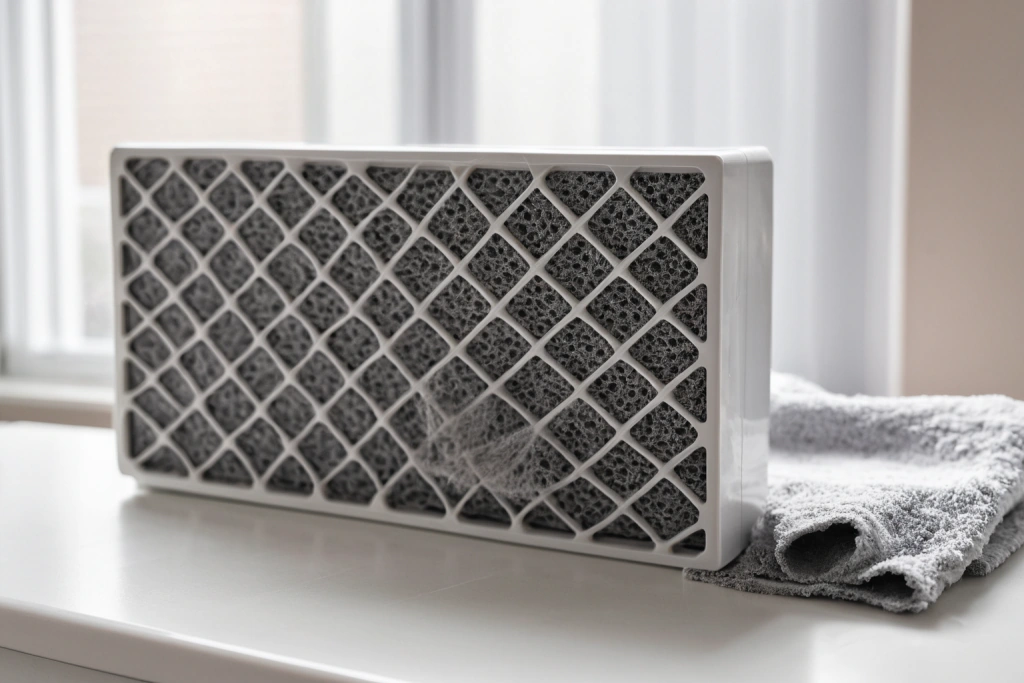
A clogged filter or a dusty coil cuts the airflow through an air conditioner, and less airflow means less cooling for the same electricity. The Dubai Electricity and Water Authority (DEWA) puts it in plain terms: clogged or dirty filters block the normal airflow and reduce the system's efficiency, and DEWA recommends cleaning them at least once a month during summer. In a dusty climate the filter is the cheapest part of the cooling system to look after and the one most often forgotten.
Two parts get dirty: the filter and the coil
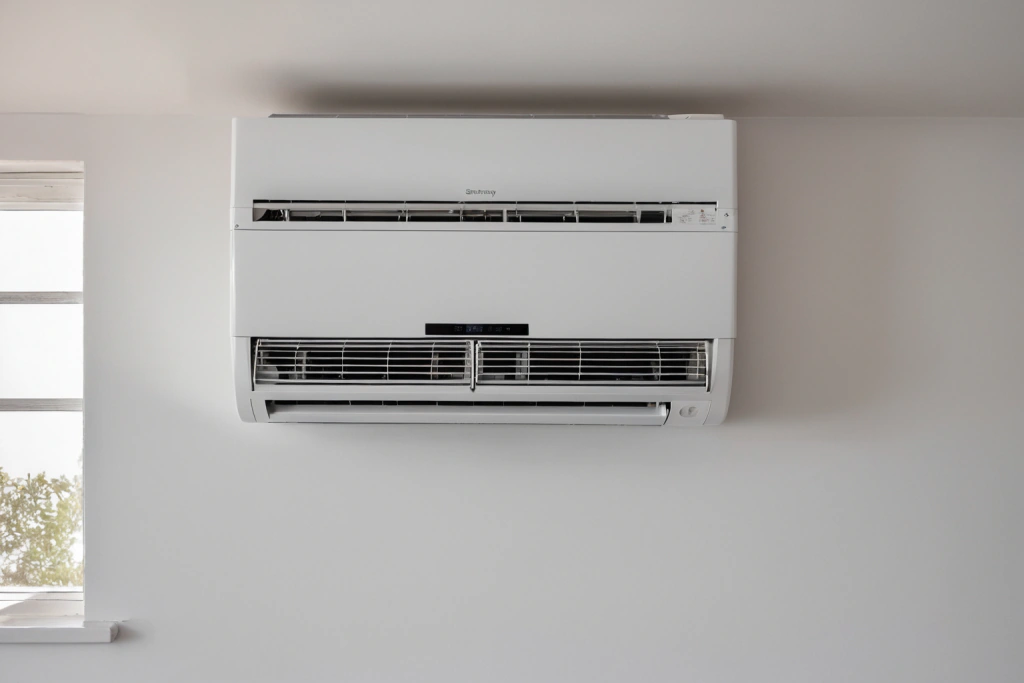
An air conditioner has two places where dust collects, and they fail in different ways. The filter is the screen or pad that air passes through first. The coil, called the evaporator, is the block of thin aluminium fins behind it where the refrigerant takes heat out of the air and water condenses. A dirty filter is visible and easy to clean. A dirty coil is hidden, and it gets dirty mainly because the filter in front of it lets dust through or air leaks around it.
ENERGY STAR, the efficiency programme of the US Environmental Protection Agency, gives a simple schedule for filters in ducted systems: check the filter every month during heavy-use months, change it if it looks dirty after a month, and change it at least every three months. A dirty filter, the programme notes, slows the airflow and makes the system work harder, wasting energy. For the washable mesh in a wall-mounted split unit, DEWA's monthly cleaning advice for summer is the local equivalent.
What Berkeley Lab found about coils
Coils clog slowly but surely. In a 2002 study, Jeffrey Siegel, Iain Walker and Max Sherman of Lawrence Berkeley National Laboratory combined laboratory measurements of dust deposition with data on indoor particle levels to estimate how long it takes a typical home's evaporator coil to collect enough dust to double the resistance to airflow. The study's base case, with a coarse filter and 10% of the air leaking around it, fouled in about 7.6 years, and the median across all cases was 7.1 years, well short of the 15 to 30 year life expected of a coil.
The study ranked what speeds up or slows down fouling. Filter efficiency and indoor dust levels mattered most:
| Change from the base case (coarse MERV 2 filter, 10% bypass) | Time for the coil to foul |
|---|---|
| Better filter, MERV 6 | about 1.4 times as long |
| High-efficiency filter, MERV 12 | about 10 times as long (median) |
| No air leaking around the filter | about 1.8 times as long (median) |
| More air leaking around the filter, 25% | about 0.7 times as long |
| Cleaner indoor environment | about 1.8 times as long (median) |
The authors put the typical loss of efficiency and capacity from coil fouling at less than 5%, but warned that it can be much greater for marginal systems or in extreme conditions. A home that takes in desert dust several times a year, as described in the note on dust storms and filters, is closer to the dirty end of their scale than to the clean one, since indoor particle levels drive fouling.
The outdoor unit collects sand too
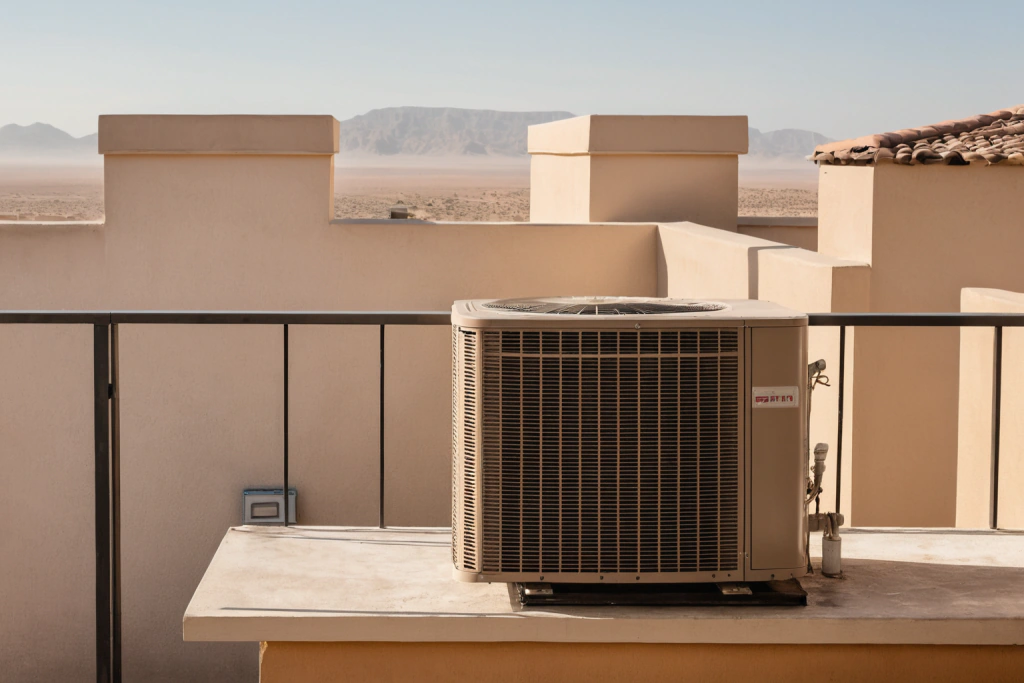
The outdoor unit has its own coil, the condenser, which throws the heat from the home into the outside air. Sand and dust on its fins make it harder to shed heat. The Berkeley Lab paper cites earlier engineering work by Krafthefter and Bonne, who estimated that the condenser coil of a typical residential heat pump fouls enough to cut performance by 20% over four to seven years, while noting reasons to think that estimate is on the high side. On a balcony or roof in the UAE, the outdoor unit faces dust storms directly, so a check after a dusty spell makes sense.
Water: the part of maintenance that prevents leaks
Every air conditioner in a humid climate is also a dehumidifier, and the water it removes has to drain away. The US Environmental Protection Agency's guide to mould lists keeping air conditioning drip pans clean and drain lines unobstructed among its basic prevention steps. A blocked condensate line overflows into ceilings, cupboards and walls, which is a common start of the problems described in the note on mould and condensation.
A maintenance plan for a UAE flat or villa
Most of the upkeep is within reach of owners and tenants. Refrigerant work and deep coil cleaning stay with a qualified technician.
- Summer, monthly: wash the mesh filters of split units, or check and replace pleated filters in ducted systems. Do it again after any dust alert.
- Every visit by a technician: ask for the indoor coil and the condensate drain to be inspected, and for the outdoor unit's fins to be cleaned if they are dusty.
- Ducted systems: fit a filter that seals in its slot, since air that bypasses the filter carries dust straight to the coil, and use the best filter the fan can handle, as covered in the note on MERV ratings.
- Winter: DEWA suggests using the mild weather to ventilate the home instead of running the air conditioning, which is also a good moment for maintenance before the next summer.
Maintenance protects efficiency that was paid for at purchase. Buyers comparing new units can read the note on the UAE's air conditioner efficiency rules, and anyone looking at the bill can see in the DEWA tariff note how cooling turns into kilowatt-hours. The cheapest kilowatt-hour is the one a ceiling fan makes unnecessary.
Sources
- Dubai Electricity and Water Authority (DEWA) (2026). Cooling: conservation tips
- ENERGY STAR, US Environmental Protection Agency (2026). Heating and cooling
- Siegel, Walker and Sherman, Lawrence Berkeley National Laboratory (2002). Dirty air conditioners: energy implications of coil fouling
- US Environmental Protection Agency (2026). A brief guide to mold, moisture and your home