Evening light at home and sleep: what the lighting research recommends
Filed in Sleep
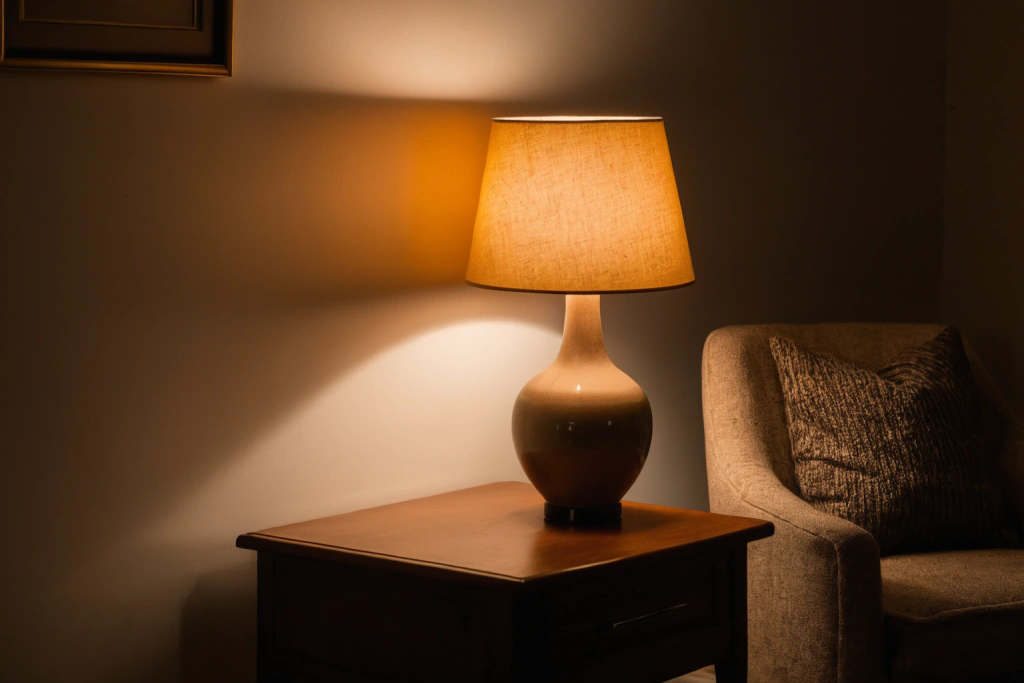
Ordinary room lighting in the hours before bed holds back the hormone that prepares the body for sleep. In a study at Brigham and Women's Hospital and Harvard Medical School, living in typical room light rather than dim light before bedtime delayed the evening rise of melatonin in 99% of participants and shortened the night-time melatonin period by about 90 minutes. A panel of sleep and lighting scientists turned that kind of evidence into numbers in 2022: bright light by day, dim light for at least three hours before bed, and near darkness while asleep.
What room light does to melatonin
Melatonin is released in the evening and through the night, and it tells the body's internal clock that night has begun. The 2011 study, led by J. J. Gooley and published in the Journal of Clinical Endocrinology and Metabolism, compared 116 healthy volunteers aged 18 to 30 who spent the eight hours before bedtime in room light, under 200 lux, or in dim light, under 3 lux. Room light suppressed melatonin, delayed its onset in 99% of individuals and cut its duration by about 90 minutes. Room light during the usual hours of sleep suppressed melatonin by more than half in 85% of trials.
Screens add to the effect. In a 2015 study in the Proceedings of the National Academy of Sciences, A. M. Chang and colleagues compared reading on a light-emitting e-reader with reading a printed book before bed. With the e-reader, participants took longer to fall asleep, felt less sleepy in the evening, secreted less melatonin, had a later internal clock and were less alert the next morning.
The 2022 recommendations
The expert panel, which published its consensus in PLOS Biology in 2022, gave its targets in melanopic equivalent daylight illuminance (melanopic EDI), a measure of light weighted for the eye's clock-setting receptors rather than for brightness alone. The figures apply at eye level, measured in the vertical plane at about 1.2 metres, the height of the eyes of a seated person.
| Time of day | Recommendation (melanopic EDI at the eye) |
|---|---|
| Daytime | At least 250 lux, using daylight first |
| Evening, from at least 3 hours before bedtime | No more than 10 lux |
| Sleep | No more than 1 lux; if light is needed at night, no more than 10 lux |
The panel added that evening light should, where possible, have a spectrum low in short wavelengths, the blue-green part of the spectrum that most strongly affects the clock, and that the same daily pattern repeated at the same times each day helps keep rhythms aligned. The recommendations were developed for healthy adults aged 18 to 55 with regular daytime schedules.
What it looks like in a UAE home
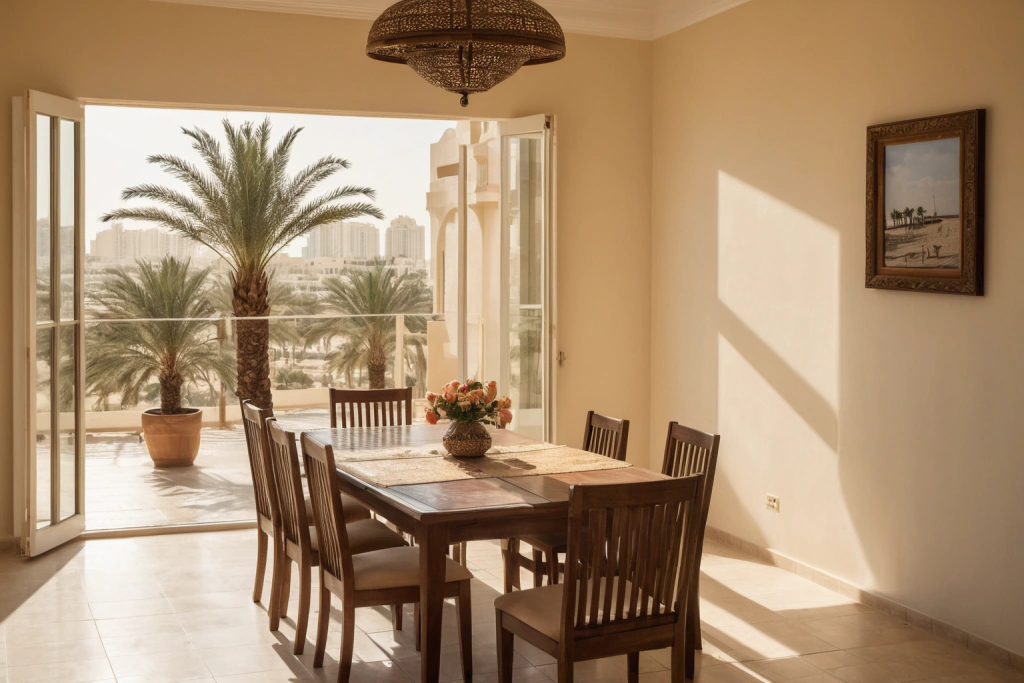
UAE evenings in winter are long, and that makes the evening target matter more: the sun sets early, and a household that goes to bed late spends many hours under electric light. Bright ceiling downlights, a large television and phones all count toward the evening total.
In a flat or villa, five habits help:
- Two lighting modes. Bright, cool light for the day and early evening; low, warm lamps for the last three hours before bed.
- Lamps instead of downlights after dark. A few dim, warm table or floor lamps make it easier to stay under the evening limit than a ceiling full of bright downlights.
- Screens dimmer and further away. The e-reader study shows that a bright screen close to the face works against sleep.
- A dark bedroom. The 1 lux limit for sleep is easiest to meet with blackout curtains against street and building lights, and with standby lights on devices covered.
- Daylight in the morning. Opening curtains or sitting near a window early in the day helps meet the 250 lux daytime target, which supports the evening drop.
Where light fits with the rest of the bedroom
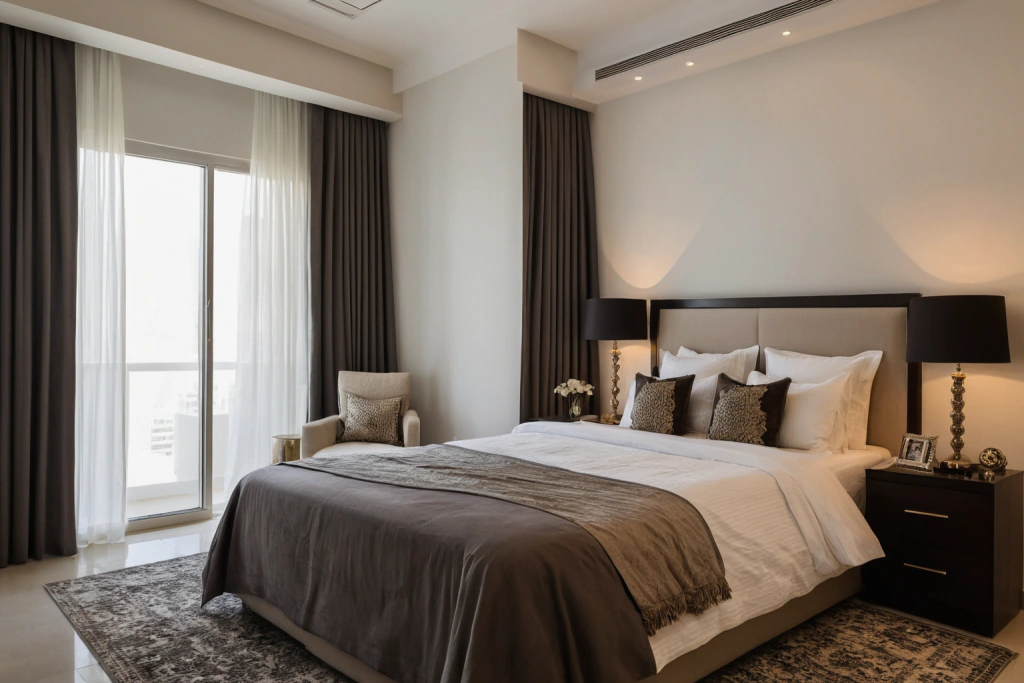
Light is one of four bedroom factors that research links to sleep. Heat and humidity are covered in the note on bedroom temperature, stale air in the note on carbon dioxide in closed bedrooms and sound in the note on noise from air conditioners and the street. Curtains that darken a bedroom also cut solar heat by day, as the note on curtains and blinds explains.
Sources
- Gooley and others, Journal of Clinical Endocrinology and Metabolism (2011). Exposure to room light before bedtime suppresses melatonin onset and shortens melatonin duration in humans
- Chang, Aeschbach, Duffy and Czeisler, Proceedings of the National Academy of Sciences (2015). Evening use of light-emitting eReaders negatively affects sleep, circadian timing, and next-morning alertness
- Brown and others, PLOS Biology (2022). Recommendations for daytime, evening, and nighttime indoor light exposure to best support physiology, sleep, and wakefulness in healthy adults